
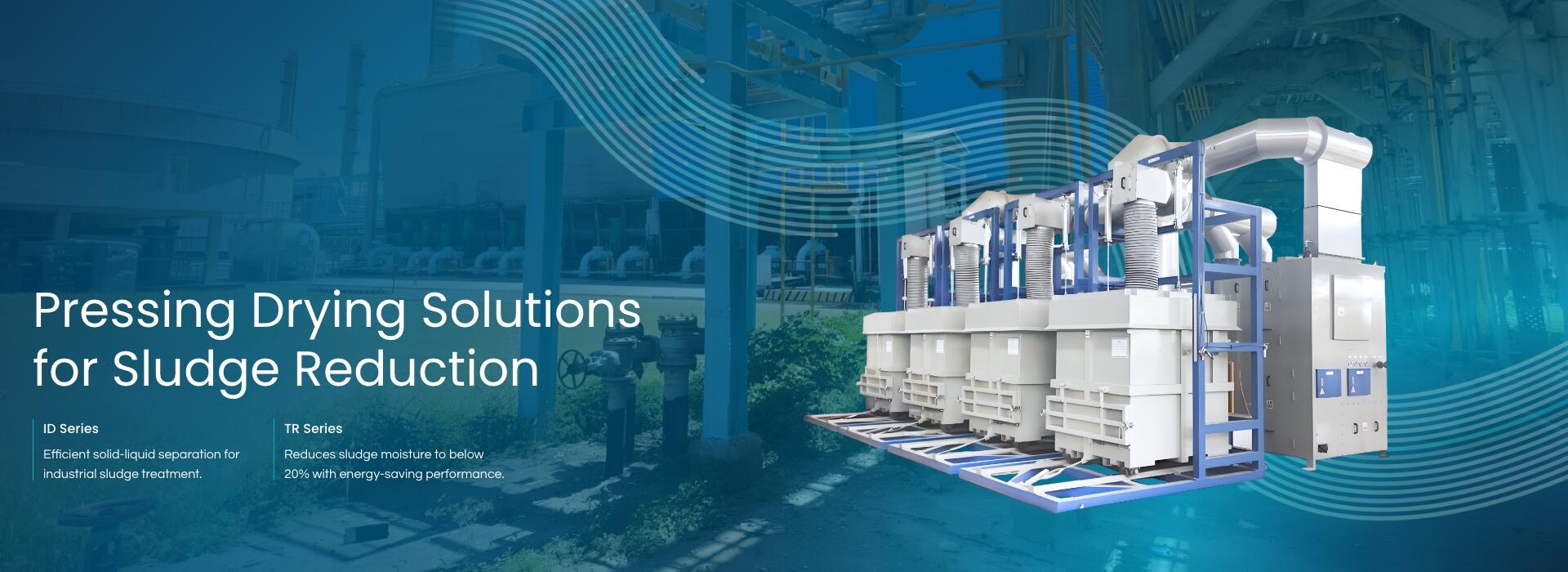
Key factors affecting the dewatering effect of sludge presses: from conditioning and feeding to model selection
How to improve the dewatering efficiency of sludge presses? The key is not just pressure, but also whether the overall conditions are stable.
In wastewater and industrial wastewater treatment processes, sludge presses are crucial equipment for converting liquid or semi-solid sludge into transportable sludge cakes. Rather than simply discussing sludge reduction, the core value of sludge presses lies in how to achieve a more stable sludge output state during continuous treatment through stable feeding, an effective solid-liquid separation mechanism, and a suitable pressing structure.
The properties of sludge generated by different industries vary greatly. For example, food processing sludge may contain high levels of organic matter, chemical and petrochemical sludge may be highly viscous, and dyeing, finishing, and papermaking sludge may contain fibers or suspended solids. These differences directly affect the processing efficiency of the sludge press. Therefore, when selecting a sludge press, one should not only look at the processing capacity on the equipment specifications, but also understand the characteristics of the sludge itself and the on-site operating conditions.
The core function of a sludge press is not simply to squeeze out water.
Many people understand sludge presses as devices that "press out the water from sludge," but in reality, dewatering efficiency does not depend solely on the pressure. If the sludge particles are too fine, the flocculation effect is insufficient, or the feed concentration fluctuates too much, even increasing the pressing pressure may not yield an ideal sludge cake.
The key to operating a sludge press is to first create a structure suitable for dewatering the sludge, and then gradually remove the water through mechanical means such as filter cloth, screw, rollers, or plate and frame. In other words, what truly affects dewatering performance is not only the equipment itself, but also the pre-treatment, feed stability, and operating parameters.
A stable sludge pressing system should ensure good solid-liquid separation conditions for the sludge before it enters the pressing section. This allows the equipment to maintain stable sludge output and avoids problems such as sludge spillage, clogging, turbid filtrate, or poorly formed sludge cake.
The first key factor affecting pressing performance: sludge conditioning
Before entering the press, sludge typically needs to be treated with chemicals to coagulate fine suspended particles into larger flocs. The state of floc formation directly affects the subsequent dewatering effect.
If the reagent is insufficient, the sludge particles cannot effectively aggregate and are prone to penetrating the filter cloth after entering the pressing zone, causing filtrate turbidity or sludge loss. If the reagent is excessive, it may make the sludge too viscous, which will reduce drainage efficiency and even increase the burden of cleaning the filter cloth.
Therefore, sludge conditioning is not simply a matter of adding chemicals to improve its effectiveness; adjustments must be made based on sludge concentration, pH value, suspended solids characteristics, and on-site water quality conditions. A stable floc structure is fundamental to improving pressing efficiency.
The second key factor affecting pressing performance: stable feed concentration and flow rate.
The biggest problem for sludge presses is not large processing capacity, but unstable feed conditions. When the sludge concentration fluctuates greatly, the flow rate fluctuates too much, or the front-end concentration effect is inconsistent, the equipment will have difficulty maintaining a consistent dewatering performance.
For example, if the feed is too thin, the equipment needs to process a large amount of moisture, which will reduce the effective pressing efficiency; if the feed is too thick or contains foreign matter, it may cause local blockage, uneven load on the fabric surface, or discontinuous mud discharge. These problems are not necessarily due to equipment failure, but rather to a lack of stable coordination of the overall system conditions.
Therefore, when planning a sludge press, the upstream thickening tank, mixing equipment, feed pump, chemical system, and sludge temporary storage conditions should be evaluated simultaneously. Only with a stable feed can the press achieve its intended processing efficiency.
Application differences of different types of sludge presses
Common sludge pressing equipment includes belt filter presses, screw presses, and plate and frame filter presses. Different types of equipment have different dewatering methods, operating characteristics, and applicable scenarios.
Filter-type dewatering machines are suitable for continuous operation and are typically used in sludge dewatering applications requiring stable throughput and long operating times. Their key feature is continuous sludge feeding and discharging, making them suitable for integration with automated processes.
Screw presses are commonly used in applications requiring low speed, low noise, and simplified operation, making them suitable for some small to medium-sized sludge treatment needs. Their relatively compact structure offers advantages for spaces with limited room.
Plate and frame filter presses are batch pressing equipment that can usually achieve a high degree of sludge cake dryness, but the operation cycle and manpower requirements are high. They are suitable for specific industries or situations where the moisture content of the sludge cake is strictly required.
Therefore, no single sludge press can be suitable for all types of sludge. The correct approach is to conduct a comprehensive assessment based on the sludge source, processing volume, operating time, manpower allocation, space conditions, and downstream treatment methods.
Common on-site questions: Why does the same equipment sometimes produce worse results?
If, after a period of use, the sludge cake becomes wet, the filtrate becomes turbid, the processing capacity decreases, or the equipment cleaning frequency increases, it is usually necessary to check the system conditions item by item, rather than simply assuming that the equipment is aging.
Common causes include unsuitable reagent type, changes in reagent concentration, alteration of sludge properties, filter cloth clogging, insufficient flushing water pressure, abnormal feed pump flow, or fluctuations in upstream wastewater quality. These factors can all cause a decline in the originally stable pressing effect.
Therefore, the maintenance of sludge pressing equipment involves more than just replacing parts; it also includes regularly observing the sludge output, filtrate clarity, filter cloth cleaning effectiveness, and feed stability. These on-site signals allow for early assessment of whether system adjustments are needed.
What conditions should be evaluated when selecting a sludge press?
During the equipment selection phase, it is recommended to confirm at least the following conditions: sludge source, daily processing capacity, sludge solids content, expected operating time, available site space, back-end removal method, whether continuous operation is required, and the acceptable maintenance frequency for on-site personnel.
Providing actual sludge samples for testing is usually more effective in determining whether the equipment is suitable for the specific sludge conditions. This is because even though it's sludge, the viscosity, particle size, oil content, and organic matter ratio vary across different industries, meaning actual dewatering performance cannot be judged solely based on theoretical data.
For owners, the focus of equipment selection is not on pursuing the highest single performance, but on finding a stable solution that best suits the site conditions. Stable operation, ease of maintenance, and controllable sludge discharge are the truly important indicators for long-term use.
In conclusion, good dehydration efficiency comes from the combination of equipment and operating conditions.
Whether a sludge press can achieve good dewatering results depends on many factors, including equipment design, sludge characteristics, chemical conditioning, stable feed, and on-site maintenance. The press itself is the core equipment, but it is not the only factor.
If sludge conditions can be understood during the planning stage, and appropriate pretreatment, chemical systems and operating parameters are used, the stability of sludge dewatering can be effectively improved, on-site abnormalities can be reduced, and subsequent transportation and treatment processes can be made smoother.
For industries that require long-term sludge treatment, choosing a suitable sludge press is not just about equipment procurement, but also a crucial foundation for the stable operation of the entire wastewater treatment system.