
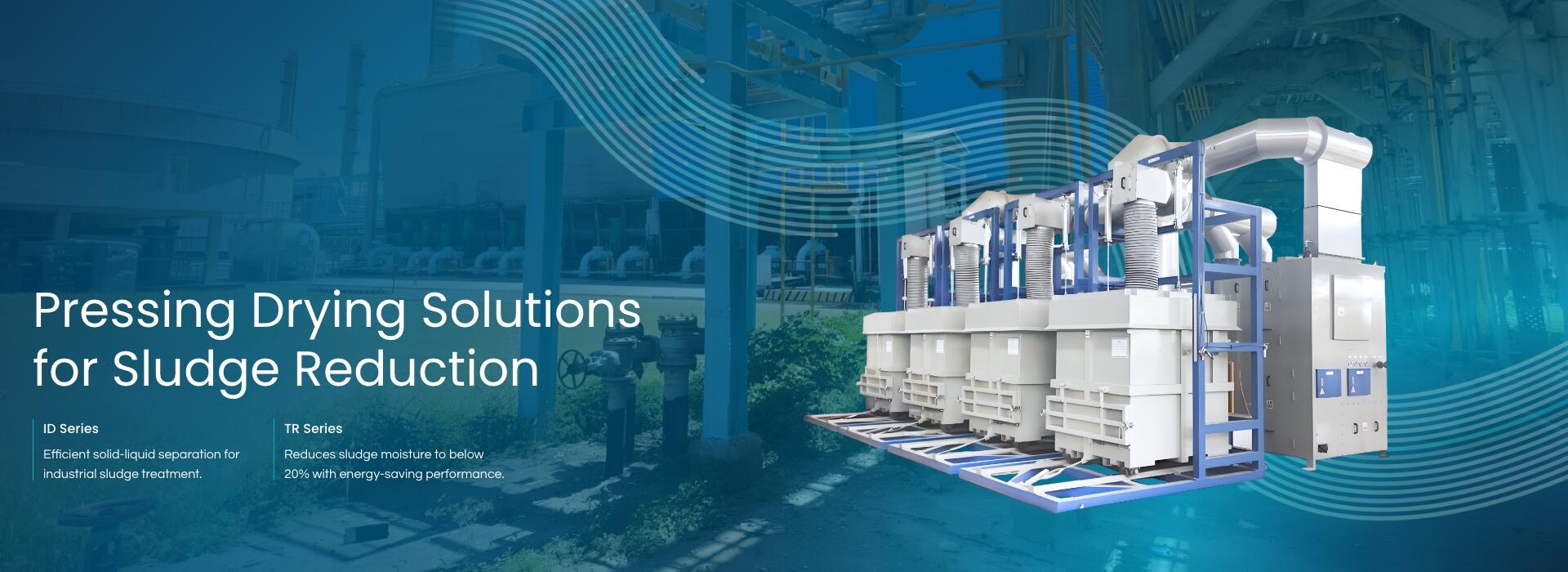
The Complete Sludge Reduction Path from Dewatering to Drying
In wastewater treatment systems, sludge reduction often cannot be achieved by a single piece of equipment alone. Under most treatment conditions, sludge dewatering and drying are two connected stages: the first stage reduces free water through dewatering, while the second stage further removes residual moisture through drying, allowing the overall volume and weight to be reduced more effectively.
Why Is Sludge Reduction Usually Divided into Two Stages?
The water contained in sludge is not all the same. Front-end dewatering equipment mainly handles water that can be separated more easily, bringing sludge from a high-moisture condition to a state more suitable for downstream treatment. When the sludge still has relatively high moisture content but has already formed into cake, further reduction will require a drying stage. This is why sludge dewatering and drying are usually planned as connected processes rather than alternatives.
Stage 1: Sludge Dewatering
In the front-end reduction stage, the main purpose of sludge dewatering is to lower sludge moisture content, reduce volume and weight, and transform the sludge from a liquid or semi-liquid condition into a more stable cake form. Taking the ID Series filter press as an example, it can serve as an important front-end unit before drying, preparing concentrated sludge for downstream drying under more suitable conditions.
Stage 2: Sludge Drying
After front-end dewatering, if further reduction in moisture content and volume is still required, the process enters the drying stage. The TR Series heat pump sludge dryer can serve as a downstream reduction unit. Through low-temperature heat pump drying and a closed-loop circulation system, it further removes residual moisture from the sludge, making the reduction effect more significant while also improving subsequent hauling, storage, and disposal conditions.
The Reduction Process from ID to TR
In practical planning, sludge reduction can usually start with dewatering equipment and then be connected to drying equipment. Using the ID Series together with the TR Series as an example, concentrated sludge can first be dewatered into sludge cake and then introduced into the drying process for further moisture reduction. This two-stage configuration not only helps improve reduction efficiency step by step, but also provides greater flexibility in overall system planning.
Sludge Reduction Flow Example
Concentrated sludge (98% moisture content) → ID Series dewatering (75% moisture content) → TR Series heat pump sludge dryer drying (45% moisture content) → Reduced volume and hauling burden
Note: The above moisture content values are for process illustration only. Actual data should be evaluated based on sludge characteristics, equipment configuration, upstream dewatering conditions, feed condition, operating parameters, and site conditions.
Transportation and Treatment Cost Benefit Estimate
Beyond the reduction in moisture content, what customers often notice more directly is the difference in hauling and treatment costs resulting from the lower total sludge weight. The following example uses a basis of 1,500 kg/day of dry solids, power consumption of 0.65 kWh per kilogram of water removed, an electricity rate of 4 per kWh, a hauling cost of 7.7 per kg, and 240 operating days per year.
| Item | After ID Dewatering | After TR Drying |
| Sludge Moisture Content | 75% | 45% |
| Dry Solids (D.S.) | 1,500 kg/day | 1,500 kg/day |
| Water Weight | 4,500 kg/day | 1,227 kg/day |
| Total Weight | 6,000 kg/day | 2,727 kg/day |
| Water Removed by TR | — | 3,273 kg/day |
| Power Consumption per kg of Water Removed | — | 0.65 kWh/kg-H₂O |
| Electricity Price | — | 4 per kWh |
| TR Daily Power Cost | — | 8,509.8 /day |
| Annual Hauling Cost | 11,088,000 /year | 7,082,676 /year (including power cost) |
| Annual Cost Saving | 4,005,324 /year | |
This estimate shows that when sludge is dewatered to approximately 75% moisture content by the ID Series and then dried to 45% by the TR Series, the daily hauling weight can be reduced from 6,000 kg to about 2,727 kg. For sites that require long-term treatment and regular hauling, this two-stage reduction configuration can often be reflected more clearly in annual cost differences. Actual moisture content and reduction results should still be evaluated based on sludge characteristics, equipment configuration, and site operating conditions.
Reduction Benefits Go Beyond Lower Moisture Content
The purpose of sludge dewatering and drying is not only to lower the moisture content shown in the numbers, but more importantly to make the overall treatment process easier to manage. When sludge weight decreases and volume becomes smaller, hauling frequency, storage pressure, and downstream disposal burden can usually all be reduced as well, which is beneficial for both on-site operation and long-term management.
How to Evaluate a Suitable Reduction Configuration
Whether sludge treatment needs to extend from dewatering to drying should be evaluated based on actual conditions, including sludge characteristics, target moisture content, daily treatment capacity, available site space, and downstream disposal methods. If only general dewatering reduction is required, front-end equipment may already be sufficient. If further volume reduction, improved storage and transport conditions, or stronger downstream disposal efficiency is required, then a drying system can be planned accordingly.
If you are evaluating a sludge dewatering and drying reduction process, feel free to contact FU CHAN MACHINERY. We can help plan a more suitable two-stage system solution according to your sludge condition and treatment requirements.